Updated on
If you have been diagnosed with low B12, or think you might have it, this guide gives you a clear overview of vitamin B12 deficiency. You’ll learn how it develops, what signs to watch for, how to test for it, and how to treat it before damage occurs.
What Is Vitamin B12 Deficiency?
B12 deficiency is a widespread condition. From vegans to meat eaters, from babies born to deficient mothers to the elderly, it affects people across the entire demographic spectrum. In the Framingham Offspring Study, 39% of participants had low B12 levels, either a clear deficiency or a borderline deficiency. Unfortunately, because the symptoms can be subtle or mimic other conditions, B12 deficiency often goes untreated.
Here are the basics:
Vitamin B12 is vital for the nervous and immune systems. It helps form red blood cells, repair DNA, reduce homocysteine, and maintain the myelin sheath that insulates your nerves. When myelin is stripped away, the brain, spinal cord, and peripheral nerves all take damage. Left untreated for too long, some damage can become permanent.
To be absorbed, B12 must follow a complex pathway that requires multiple steps. Normal function of the stomach, pancreas, and small intestine is needed, and problems at any point in that process can lead to malabsorption—and eventually deficiency.
In most cases, B12 deficiency is actually caused by malabsorption rather than low dietary intake. For example, chronic stomach inflammation and autoimmune activity can interfere with the digestive system, reducing the body’s ability to absorb B12.
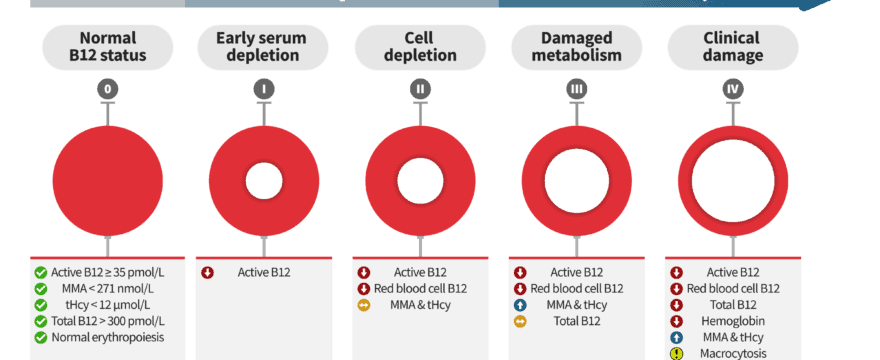
Vitamin B12 deficiency progresses in four stages. It typically begins with declining blood levels (stage I), followed by low cellular levels (stage II), increased homocysteine levels and reduced DNA synthesis (stage III), and finally macrocytic anemia (stage IV). In some cases, however, blood levels can appear normal even in later stages.
For these reasons, B12 deficiency has been called a silent epidemic. Early signs are vague and easy to dismiss, but by the time severe symptoms appear, nerve damage may already be present. Unfortunately, the nervous system cannot always fully regenerate, so people with advanced neurological symptoms may never regain their full function.
Explore B12 Deficiency
You can start by watching this video. It doesn’t cover some of the more recent topics on our site, such as the MTHFR mutation, but it’s still very educational:
Browse the following articles to learn more about the causes, symptoms, stages, testing, and treatment of B12 deficiency. We designed this resource to help you understand the condition in depth. It will explain why obvious signs like cognitive decline and fatigue are often mistaken for normal aging, even by healthcare professionals.
- B12 Deficiency Signs and Symptoms — Study the full range of symptoms, from fatigue and tingling to memory and mood changes.
- The Causes of B12 Deficiency — Understand the most common causes, including malabsorption, diet, and autoimmune issues.
- Treating B12 Deficiency — Explore the main treatment options, and see why early treatment is so critical in this condition.
- B12 Deficiency in Vegetarians and Vegans — See why plant-based diets increase the risk, and what you can do about it if you follow such a diet.
- B12 Deficiency Diagnostic Tests — Learn which tests are most useful for detecting B12 deficiency, and why some of them miss so many cases.
- Feeling Like You’re Dying — Read about the severe physical and mental effects people report when B12 deficiency persists long enough.
- The Four Stages of B12 Deficiency — Follow the natural progression from early biochemical changes to clinical anemia.
- Recovering from B12 Deficiency — Find out what affects recovery time, and what to expect during and after treatment.
With gratitude
We’re grateful to Sally Pacholok for her work raising awareness of B12 deficiency. Read her book, Could It Be B12?, or watch the film based on her incredible story:
Feel free to share this guide with your doctor.
All the best.